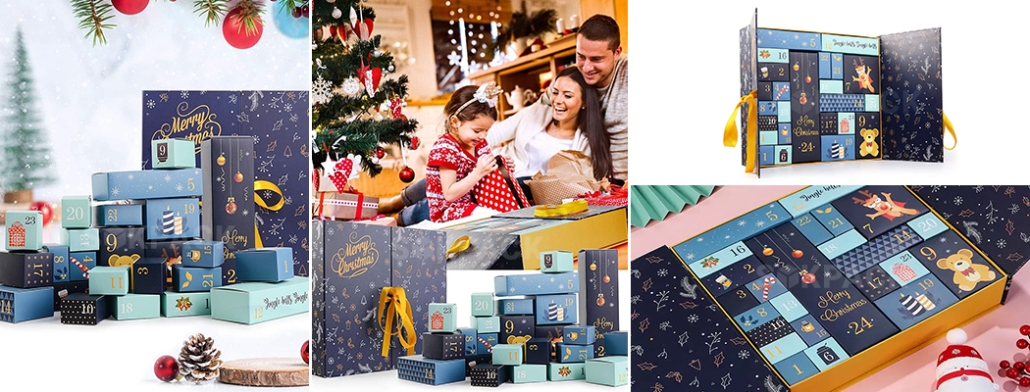
How to Design an Advent Calendar Box: Complete Guide
From structure to sustainability — everything you need to know to create an advent calendar box that sells.
Why Advent Calendar Packaging Matters More Than Ever
The global advent calendar market is projected to reach $3.8 billion by 2025, growing at a compound annual rate of 7.4%. What started as a chocolate-only tradition has expanded into beauty, skincare, wine, food, toys, candles, and even DIY craft kits.
But here’s what many brands overlook: the box itself has become the product.
On TikTok alone, the hashtag #adventcalendar has accumulated over 4.2 billion views. Consumers don’t just buy advent calendars for what’s inside — they buy them for the ritual of opening one small door or drawer each day. The packaging is the experience.
For brands and private-label businesses, this means the advent calendar box isn’t just a container. It’s a marketing tool, a social media asset, and often the deciding factor in whether a customer chooses your product over a competitor’s.
“In the premium advent calendar segment, packaging accounts for up to 40% of the perceived product value. A well-designed box doesn’t just protect — it sells.” — Packaging Insights Europe, 2025
This guide walks you through the entire design process, from choosing a structure to selecting materials, printing techniques, and sustainability considerations. Whether you’re launching your first advent calendar or refining an existing design, here’s everything you need to know.
Step 1: Choose Your Box Structure
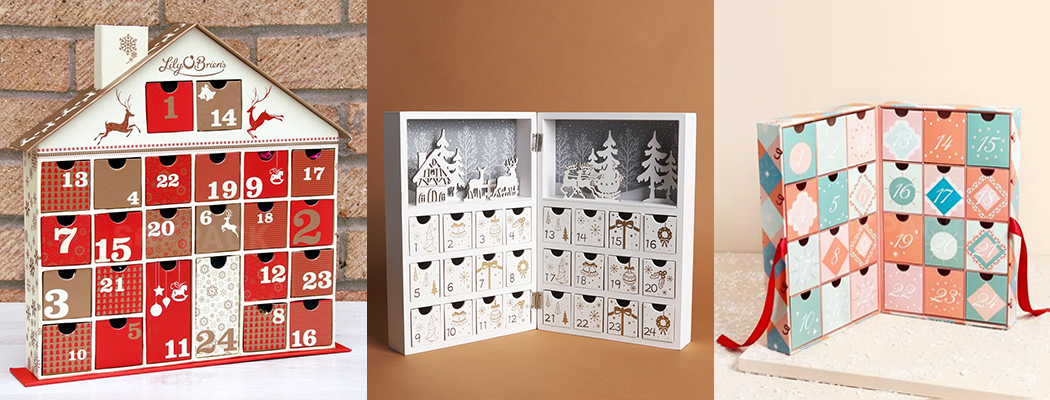
The structure is the foundation of your advent calendar box. It determines how customers interact with your product, how it ships, and how much it costs to produce. Here are the four most common structures, each with distinct advantages.
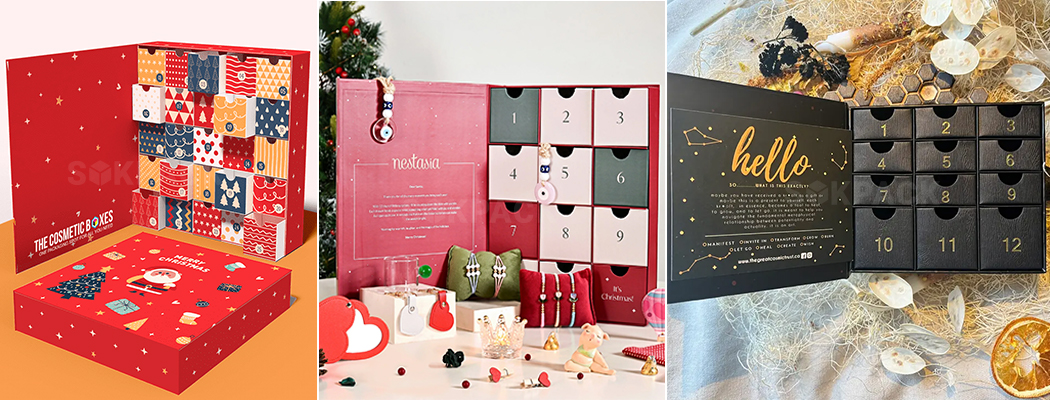
1. Drawer-Style Boxes
Each day is revealed by pulling out a small drawer. This is the most popular structure for beauty advent calendars because it creates a satisfying tactile interaction.
- Best for: Beauty, skincare, jewelry, small accessories
- Compartments: Typically 24 (standard advent) or 25 (including a bonus reveal)
- Pros: Premium feel, easy to manufacture, strong shelf presence
- Cons: Higher material usage per unit, requires precise alignment
2. Double-Door Boxes
Two panels open like French doors to reveal numbered windows or perforated tear-off sections behind them. Classic, elegant, and deeply associated with the traditional advent calendar experience.
- Best for: Chocolate, confectionery, gourmet food, toys
- Pros: Strong visual impact, tradition-driven design, cost-efficient
- Cons: Less interactive than drawers, windows can tear unevenly
3. Flip-Top / Lid Boxes
A single lid lifts to reveal a grid of compartments beneath. Simple, clean, and practical — ideal when the focus should be on the contents rather than the packaging mechanics.
- Best for: Tea, coffee, snacks, craft kits, candles
- Pros: Easy to open, low tooling cost, versatile compartment shapes
- Cons: Less dramatic reveal, contents visible at once
4. Accordion / Fold-Out Boxes
The box unfolds horizontally or vertically to reveal compartments in sequence. A less common but highly distinctive structure that stands out on shelves and in social media content.
- Best for: Premium beauty, limited editions, wine and spirits
- Pros: Highly photogenic, strong unboxing narrative, premium perception
- Cons: Complex tooling, higher production cost, requires more display space
Structure Selection Quick Guide
Beauty & Skincare → Drawer-style (most expected by consumers)
Chocolate & Confectionery → Double-door with windows (traditional appeal)
Wine & Spirits → Tiered or accordion fold-out (premium positioning)
DIY & Crafts → Flip-top with numbered compartments (practical access)
Step 2: Select the Right Materials
Material selection affects durability, print quality, sustainability credentials, and cost. Here’s a practical breakdown of the most common options for advent calendar boxes.
| Material | Weight / Thickness | Best For | Cost Level | Eco-Rating |
|---|---|---|---|---|
| SBS (Solid Bleached Sulfate) Paperboard | 250–400 gsm | High-end rigid boxes, luxury finishing | High | Moderate |
| Greyboard (Chipboard) | 1.0–2.5 mm | Rigid box structure walls | Low–Medium | Good (recyclable) |
| FSC-Certified Cardboard | 300–450 gsm | Eco-friendly full-wrap boxes | Medium | Excellent |
| Kraft Paperboard | 250–350 gsm | Natural/organic aesthetic, simple structures | Low | Excellent |
| Corrugated E-Flute | 1.0–1.8 mm | Shipping-friendly, lightweight options | Low | Good |
Inner Trays and Inserts
The compartments inside your advent calendar need individual inserts to hold products securely. Common insert materials include:
- Molded pulp — Made from recycled paper fiber, fully biodegradable. The most sustainable option. Ideal for food-grade applications.
- Die-cut cardboard dividers — Cost-effective, printable, recyclable. Best for lightweight items like tea bags or small cosmetics.
- Fabric or velvet inserts — Reserved for luxury jewelry or premium beauty calendars. High perceived value but non-recyclable.
- PET film windows — Transparent, food-safe, and recyclable (PET #1). Used when customers should see the product through the compartment.
SOKPACK Tip: Food-Safe Certification
If your advent calendar will contain chocolate, snacks, tea, or any food-contact product, make sure your packaging supplier can provide FDA-compliant or EU food-contact certified materials. This is non-negotiable for food brands entering the US or European market.
Step 3: Design for the Unboxing Experience
With advent calendars, the unboxing isn’t a single moment — it’s a 24-day experience. Your design needs to account for how the box looks, feels, and functions over the entire countdown period.
Visual Hierarchy
- Numbers must be prominent. Day 1 through Day 24 (or 25) should be clearly legible. Use a font size of at least 14pt and high contrast against the background.
- Create visual progression. Consider a subtle gradient, pattern evolution, or color shift that progresses from Day 1 to Day 24 — it creates a sense of journey and anticipation.
- Reserve a “wow” moment for the final day. The last compartment (often Day 24 or 25) should feel special — larger, differently designed, or positioned as the centerpiece of the box.
Tactile Design
- Drawer pulls and ribbon tabs. Small physical handles on each drawer or tab make the daily ritual feel more intentional and premium.
- Magnetic closures. If your box has a main lid or door, magnetic closures add a satisfying “snap” when opening and closing.
- Texture contrast. A matte exterior with glossy numbered accents, or a soft-touch laminate with foil-stamped numbers, creates tactile interest that encourages sharing on social media.
After-Life Design (Second Life)
One of the fastest-growing trends in advent calendar packaging is “second-life” design — boxes that serve a purpose after the countdown is over. Examples include:
- Drawer boxes that become a jewelry organizer or desk tidy
- Calendar boxes that convert into a photo frame or display shelf
- Boxes with reversible panels that become home decor after the holidays
This is not just a design choice — it’s a sustainability statement and a powerful marketing angle. In consumer surveys, 67% of advent calendar buyers say they would pay more for a box they can reuse.
Step 4: Pick Your Printing & Finishing Techniques
The finishing techniques you choose directly impact perceived value. Here’s a practical guide to what works best for advent calendar boxes.
Essential Techniques
| Technique | Effect | Cost Impact | Best Used For |
|---|---|---|---|
| Foil Stamping | Metallic accent on logos, numbers, borders | +15–25% | Luxury positioning, premium branding |
| Embossing / Debossing | 3D raised or recessed pattern on paper surface | +10–20% | Brand logos, decorative patterns |
| Spot UV Coating | Glossy highlight on specific areas over matte base | +8–15% | Number highlights, graphic accents |
| Soft-Touch Lamination | Velvety, fingerprint-resistant matte surface | +10–18% | Beauty and premium lifestyle brands |
| Die-Cut Windows | Custom-shaped openings revealing contents or pattern | +12–20% | Food calendars, peek-a-boo product reveals |
| Laser-Cut Details | Precise, intricate cut patterns in the paper | +20–35% | Limited editions, artistic positioning |
Design Tip: Less Is More
For advent calendar boxes, resist the temptation to layer every technique at once. The most effective designs typically combine one primary technique (e.g., foil stamping) with one secondary technique (e.g., soft-touch lamination). Overloading techniques creates visual noise and drives up cost without proportional value gain.
Step 5: Integrate Sustainability
Sustainability in advent calendar packaging has moved from “nice to have” to “must have” — especially for the European market. In 2025, 73% of UK consumers said they would choose a more sustainable advent calendar over a non-sustainable alternative at the same price point.
Practical Sustainability Checklist
- FSC-Certified Paper — Use paper and board sourced from responsibly managed forests. This is the single most impactful credential you can add.
- Eliminate Plastic Windows — Replace PVC windows with PET (recyclable #1), cellulose acetate (biodegradable), or open die-cut designs with no film at all.
- Soy-Based or Water-Based Inks — Replace petroleum-based inks with vegetable-based alternatives. They perform identically on press and are easier to de-ink during recycling.
- Minimize Mixed Materials — The harder it is for consumers to separate materials, the less likely they are to recycle correctly. Aim for single-material designs (all-paper or all-cardboard).
- Design for Flat Shipping — Fold-flat or knock-down designs reduce shipping volume by 40–60%, cutting both costs and carbon emissions.
- Second-Life Function — As discussed in Step 3, designing the box to be reusable after the holidays reduces waste and adds functional value.
Communicating Sustainability
Don’t just make sustainable choices — tell your customers about them. Print your sustainability credentials on the box itself:
- “FSC Certified — Made with paper from responsible sources”
- “100% Recyclable — Please recycle this box”
- “Plastic-Free Packaging”
- “Designed for a Second Life — Reuse as a storage box”
- “Printed with Soy-Based Inks”
Step 6: Plan for Production
Designing a great advent calendar box is only half the challenge. Getting it produced on time, at the right quality, and within budget requires careful production planning.
Typical Production Timeline
| Phase | Duration | What Happens |
|---|---|---|
| Design & Dieline | 3–5 days | Finalize artwork, create structural dieline, approve 3D mockup |
| Prototyping | 5–7 days | Physical white sample → printed color sample → final approval |
| Tooling & Setup | 7–10 days | Die-cutting rules, printing plates, foil stamping dies |
| Mass Production | 15–25 days | Printing → finishing → assembly → quality inspection |
| Shipping | 7–15 days (sea) / 3–5 days (air) | Packed on pallets, loaded for sea freight or air cargo |
Critical timing note: Most brands finalize their advent calendar designs in June–July and need stock ready by September–October for pre-sale campaigns. If you’re a brand planning for Christmas 2026, you should begin working with your packaging supplier by April or May at the latest.
MOQ & Cost Considerations
- Typical MOQ: 300–500 units for custom advent calendar boxes. Some manufacturers offer lower MOQs (100 units) with a price premium.
- Unit price range: $0.50–$2.50 for standard cardboard boxes; $4.00–$8.00 for luxury rigid boxes with foil and soft-touch finishing.
- Cost drivers: Material choice, number of finishing techniques, number of colors, structural complexity, and order quantity all affect per-unit pricing.
SOKPACK Production Capabilities
At SOKPACK, we specialize in custom advent calendar box manufacturing with a 20,000+ sqm production facility, 15+ years of OEM/ODM experience, and a 7–15 day sample-to-shipment turnaround. We work with brands like Nestle, Ferrero, JBL, and Logitech to deliver packaging that elevates products and drives sales.
7 Common Mistakes to Avoid
- Starting Too Late. The #1 mistake brands make. Production lead times for custom advent calendar boxes are 30–50 days. Add design and prototyping, and you need at least 3 months before your target stock date.
- Ignoring Sustainability. In 2026, an advent calendar box without any sustainability credentials will lose shelf space in major European retailers. FSC certification and plastic-free design should be baseline, not premium.
- Overcomplicating the Structure. More moving parts mean more assembly time, higher defect rates, and increased shipping damage risk. Start with a proven structure and differentiate through graphics and finishing.
- Neglecting the Unboxing Sequence. The daily reveal is the core experience. If customers can see all 24 compartments at once (without an element of discovery), you’ve lost the magic.
- Using Mixed Materials. Combining plastic windows, metal hinges, fabric lining, and foil-stamped cardboard creates recycling confusion. Consumers increasingly reject packaging they can’t easily separate.
- Skipping Physical Prototypes. Digital renders look perfect — real boxes don’t always. Always approve a physical sample before committing to mass production.
- Underestimating Shipping Volume. A fully assembled advent calendar box is bulky. Designing for flat-pack shipping can reduce your shipping volume by 40–60% and significantly cut freight costs.
Frequently Asked Questions
How much does a custom advent calendar box cost?
Prices range from $0.50–$2.50 per unit for standard printed cardboard boxes (MOQ 500+) to $4.00–$8.00 per unit for luxury rigid boxes with premium finishing like foil stamping and soft-touch lamination. Final pricing depends on material, structure complexity, finishing techniques, and order quantity.
What’s the minimum order quantity (MOQ) for custom advent calendar boxes?
Most manufacturers set MOQ at 300–500 units. Some offer lower MOQs (100 units) with a surcharge. For first-time projects, consider splitting your order: a smaller initial run for testing and a larger follow-up order for the holiday season.
How long does production take from design approval to delivery?
Typically 30–50 days total, including prototyping (5–7 days), tooling (7–10 days), mass production (15–25 days), and shipping (7–15 days by sea). Air freight can reduce shipping to 3–5 days but significantly increases cost.
Can I make my advent calendar box fully recyclable?
Yes. Use FSC-certified cardboard with soy-based inks, eliminate plastic windows (use die-cut openings instead), and avoid mixed materials like fabric or metal hinges. The entire box, including any printed inserts, should be recyclable in standard paper/cardboard streams.
What certifications should I look for in a packaging supplier?
Key certifications include FSC (responsible forestry), ISO 9001 (quality management), ISO 14001 (environmental management), BSCI/SEDEX (social compliance), and FDA compliance if your calendar contains food products. For EU markets, REACH compliance is also important.
How do I make my advent calendar box stand out on social media?
Three strategies work best: (1) Design for the reveal — each compartment opening should feel like a mini-event worth filming; (2) Use premium finishing — soft-touch lamination and foil stamping look exceptional in photos and videos; (3) Include a second-life feature — it gives influencers a natural “sustainability angle” for their content.
Ready to Create Your Advent Calendar Box?
Get a free structural design consultation and sample quote from our packaging engineers.