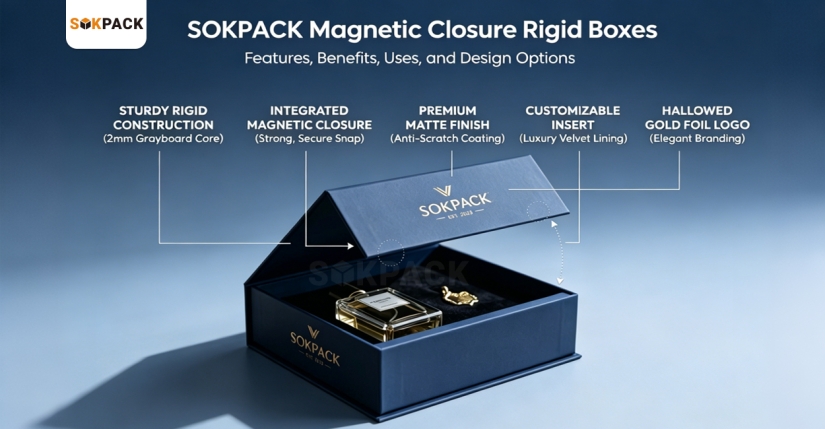
SHENZHEN, China – July 1, 2026 – In an era where the unboxing experience is as influential as the product itself, Magnetic Closure Rigid Boxes have become the gold standard for luxury packaging across beauty, jewelry, electronics, fashion, and corporate gifting. Unlike folding cartons that rely on tuck flaps or adhesives, a magnetic rigid box […]
https://sokpack.com/wp-content/uploads/2026/07/Magnetic-Closure-Rigid-Boxes-2-e1783044473772.jpg429825administratorhttps://sokpack.com/wp-content/uploads/2026/08/logo11.pngadministrator2026-07-03 02:31:542026-07-16 06:44:06Magnetic Rigid Boxes: The Gold Standard for Luxury Packaging
The FIFA World Cup 2026™ is already underway — 48 teams, 104 matches, and an estimated 5 billion global viewers. For brands and B2B companies, that kind of cultural moment creates a rare alignment: your clients and partners are all watching, feeling, and sharing the same experience at the same time.
Corporate gifting during the World Cup isn’t a gimmick. It’s strategic brand investment in a moment of peak emotional engagement. A thoughtfully packaged World Cup gift box lands on a desk during a week when your client is already talking about football — it’s contextual, timely, and memorable in a way that a standard “thank you” hamper simply cannot replicate.
This guide is written for marketing managers, procurement teams, and brand managers who want to execute a World Cup 2026 corporate gifting program — from concept to delivery — efficiently and cost-effectively.
27% Higher response rate in follow-up sales after a physical gift
70% Better retention vs. email: branded physical packaging stays longer
5B+ World Cup viewers — peak emotional engagement window
37 days Remaining tournament window to capitalize on (until July 19)
1. Why Corporate Gifting Works During the World Cup
Most corporate gifts arrive in a vacuum — a generic hamper at year-end, indistinguishable from the 10 others your client received that week. World Cup gifts are different. They arrive with built-in cultural context.
When you send a beautifully packaged World Cup gift box on the day of a major match, three things happen that don’t happen with ordinary gifting:
Immediacy: The gift is relevant right now, not “whenever you get around to opening it.” The recipient knows exactly why it’s there.
Social sharing: Sports emotion and beautiful packaging combine into a highly shareable moment. Unboxing a premium World Cup gift set in the office generates organic conversation.
Emotional anchoring: Your brand becomes associated with the positive emotions of the tournament. When your client remembers that incredible match, they’ll also remember your gift.
Key Insight: The most impactful timing windows are Round of 16 (June 28 – July 2), Quarterfinals (July 4–5), and Finals Week (July 15–19). Target delivery to coincide with match days for your client’s country or favorite team.
2. Who to Send Gift Boxes To
Before you budget and design, identify your target recipients. World Cup corporate gifts work across multiple audiences, each requiring a different approach:
Recipient Group
Gifting Goal
Recommended Tier
Timing
Key Clients / Accounts
Relationship deepening, renewal momentum
Premium ($50–$80/box)
Round of 16 / Quarterfinals
Prospective Clients
Pipeline acceleration, brand recall
Mid-range ($20–$40/box)
Tournament kickoff / Group stage
Business Partners
Partnership appreciation, co-promotion
Mid-range ($25–$50/box)
Any major match week
Employees
Morale boost, brand culture
Budget-friendly ($10–$25/box)
Tournament kickoff
Influencers / Media
Content seeding, organic reach
Premium ($60–$100/box)
Kickoff or First match week
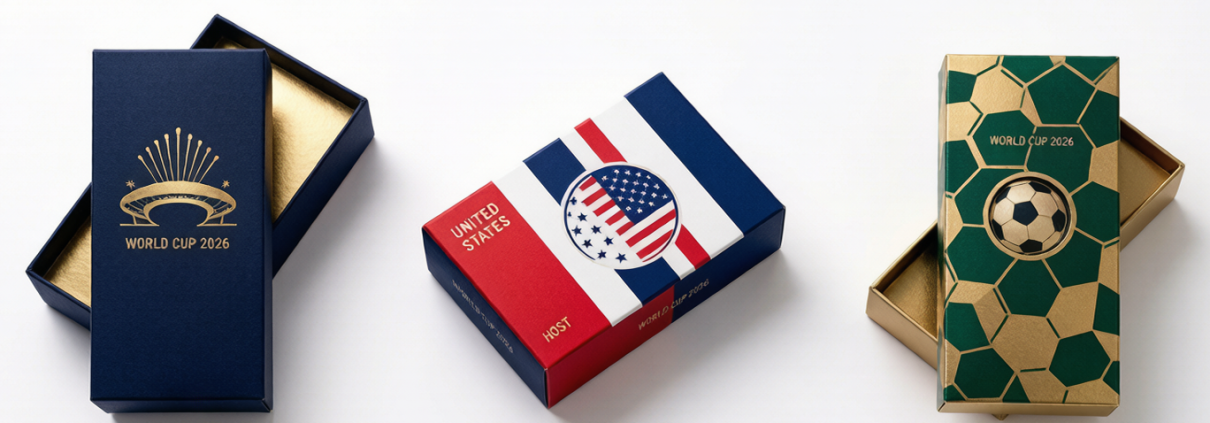
Pro Tip: For key clients in host countries (USA, Canada, Mexico), consider country-specific packaging — a red-white-blue box for US clients, a green-white-red box for Mexican partners. This hyper-local personalization shows cultural awareness and dramatically increases the emotional impact.
3. Gift Box Tiers & Budget Guide
Corporate gift boxes exist across a wide price range. Here’s a practical framework based on 2026 supplier pricing and contents cost:
🥇 Premium Tier
$50–$100
Per box, incl. contents at 500+ units
Rigid magnetic lid box with foil stamping
Soft-touch lamination + embossed logo
Premium insulated tumbler
Artisan chocolate set
Branded notebook + pen set
Enamel keepsake pin
Personalized message card
🥈 Mid-Range Tier
$20–$45
Per box, incl. contents at 500+ units
Rigid box with matte lamination
Spot UV logo accent
Branded ceramic mug
Snack or candy set
Branded tote or cap
World Cup schedule card
🥉 Budget Tier
$10–$20
Per box, incl. contents at 1,000+ units
Folding carton or kraft box
Branded glossy sleeve
Football-themed chocolates or candy
Branded cap or bandana
Mini stationery set
Total Program Budget Estimation
Recipients
Budget Tier Total
Mid-Range Total
Premium Total
100 boxes
$1,000–$2,000
$2,000–$4,500
$5,000–$10,000
500 boxes
$5,000–$10,000
$10,000–$22,500
$25,000–$50,000
2,000 boxes
$20,000–$40,000
$40,000–$90,000
$100,000–$200,000
4. Design Principles for Corporate Gift Packaging
Corporate gift boxes have one primary design constraint that consumer packaging doesn’t: the brand must be visible, but the gift must not feel like advertising. Here’s how to get that balance right:
Rule 1: Logo Prominence Without Dominance
Your company logo should appear on the exterior lid and at least one interior surface, but it shouldn’t overwhelm the World Cup theme. A good ratio: 30% brand identity, 70% World Cup mood. This feels like a gift, not a promotional item.
Rule 2: Match Energy Drives Color Choice
Use football’s energy palette — deep pitch green, trophy gold, stadium night navy, or host nation colors — as your background canvas. Overlay your brand colors as accents rather than the dominant color. A navy box with gold foil and your logo in white feels premium and football-right simultaneously.
Rule 3: Texture Tells the Story
For premium recipient tiers, the tactile experience matters as much as the visual. Soft-touch matte lamination makes a box feel intentional. Combine with an embossed logo on the lid — the moment your client picks up the box and feels the quality, before they’ve even opened it, they’ve received a message about how you value the relationship.
Rule 4: Interior Matches Exterior
Don’t let the interior contradict the exterior. If the box is premium, the interior lining, tissue color, and insert material must match. Standard checklist: custom-color tissue paper, branded ribbon pull, foam or molded pulp insert in team colors, and a card printed to match the exterior palette.
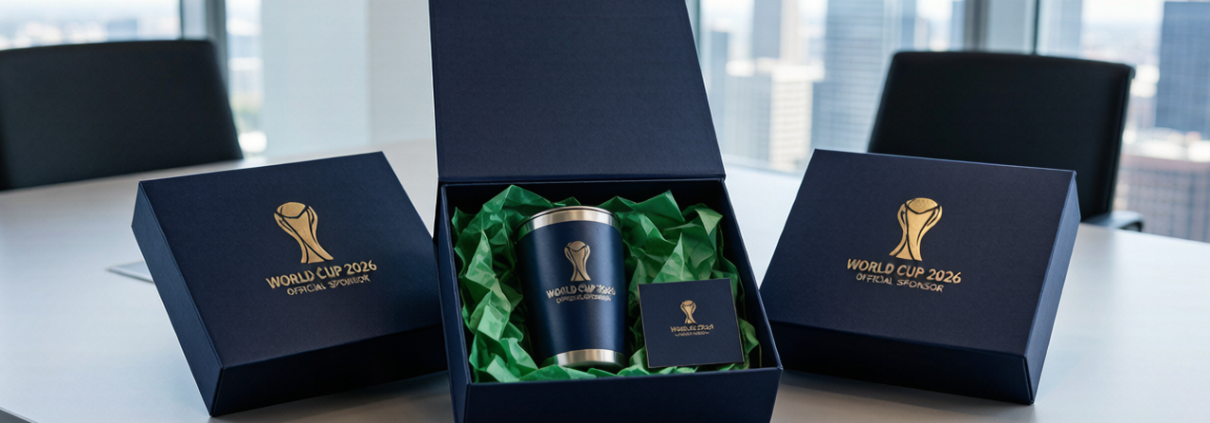
Design Direction: The most universally effective corporate World Cup box for 2026 is a deep navy rigid box with gold foil World Cup trophy silhouette on the lid, soft-touch matte exterior, white embossed company logo on the side panel, and green tissue paper interior. Works for any client, any industry, any country.
5. Contents Recommendations by Audience
The contents of your gift box should reflect what your recipient will use, display, or consume — not what’s cheapest to source. Here’s a curated guide by recipient type:
For C-Suite Executives (Premium)
🥃 Premium branded whiskey glass set or wine glasses (2 pieces)
⌚ Leather-bound desk set (cardholder + notepad + pen)
🏆 Replica World Cup trophy desk miniature (branded base)
✉️ Handwritten personalized card from your CEO
For Marketing & Creative Teams (Mid-Range)
☕ Branded specialty coffee set with World Cup packaging
📓 A5 hardcover notebook with foil logo
🎨 Limited edition branded tote bag
🍬 Colorful candy mix in team colors (US/Mexico/Canada)
📱 Branded PopSocket or phone stand
For Large Workforce Distributions (Budget-Friendly)
🧢 Branded cap or fan bandana
⚽ Mini foam football
🍭 Football-shaped chocolates (3–5 pieces)
📋 World Cup bracket card (fill-in predictions)
🎉 Branded sticker pack
6. Personalization & Variable Data Printing
The most powerful upgrade for corporate gift boxes is personalization — and modern manufacturing makes it more accessible than most procurement managers realize.
Here are three levels of personalization, from basic to advanced:
Recipient Name Card (Most Common): Print a personalized “Dear [Name]” card for each box using variable data digital printing. Supply the factory with a spreadsheet; they produce individual cards. Cost: $0.30–$0.80/unit extra. Maximum emotional impact for minimum cost.
Regional Box Variants (Intermediate): Print 2–3 exterior box variants aligned to recipient locations. USA clients get red-white-blue boxes; Mexico contacts get green-white-red. Requires 2–3 separate SKUs but is manageable at 200+ units per variant.
Fully Custom Per-Box Printing (Advanced): Digital printing allows true one-off customization — recipient name, company name, or even a personalized message on the box exterior itself. Typically feasible at 100+ units with digital printing partners. Cost premium of $1.50–$3.00/unit but creates extraordinary differentiation.
Low-Cost High-Impact Hack: Even for standard printed boxes, add a QR code on the interior base that links to a personalized video message from your team. Record one per major client segment (e.g., “For our North America partners” / “For our friends in Europe”). Cost: $0. Impact: unforgettable.
7. Logistics: Production & Delivery Timeline
With the World Cup running until July 19, 2026, here’s a realistic production and delivery roadmap starting from today, June 12:
Action
Timeline
Notes
Brief finalization + supplier quote
June 12–14
Define structure, size, qty, design direction
Design approval + dieline confirmation
June 14–17
Most factories provide template within 24hrs
Digital 3D mockup approval
June 17–18
Skip physical sample to save time
Rush production (folding carton)
June 18 – July 2
~15 days; +15% rush fee typical
Rush production (rigid box)
June 18 – July 8
~20 days; +20% rush fee typical
Air freight to USA / Europe
+5–7 days after production
Add 2–3 days for customs
Expected arrival (rigid box)
July 13–16
In time for the FIFA World Cup Final (July 19) 🏆
Don’t wait: Every day of delay is one day less tournament window. If you want boxes for the Quarterfinals (July 4–5), you need production confirmed by June 16 for folding cartons or June 13 for rush rigid boxes. Contact your packaging supplier today.
8. Four Mistakes That Kill Corporate Gift ROI
Mistake 1: Generic Contents in Premium Packaging
A $15 box of chocolates in a $7 rigid box sends a mixed message. Align contents quality with packaging quality. If your box is premium, every item inside must feel premium too — even if that means fewer items.
Mistake 2: Forgetting the Interior Experience
Most procurement managers approve the box exterior and forget about the interior. But when your client opens the box, the interior is the first thing they see. White tissue and brown inserts in a beautiful navy box feel like a let-down. Budget 10–15% of your packaging cost for interior tissue, insert, and card quality.
Mistake 3: Ordering Too Early Without Flexibility
Ordering 2,000 boxes identical to each other, then realizing three weeks in that you want to add 500 for a new client segment — is expensive. Order your core batch, but reserve 10–15% of production capacity as flex stock (plain or semi-customized boxes you can quickly finish).
Mistake 4: No Distribution Plan
The box is ready, sitting in a warehouse. Now what? Building the distribution logistics (courier accounts by country, recipient data, address verification, customs documentation for international sends) is a project unto itself. Start planning distribution as soon as production is confirmed.
Frequently Asked Questions
What makes a good World Cup corporate gift box?+
How much should a corporate World Cup gift box cost per unit?+
Can I include a personal message or variable data in each gift box?+
What is the best timing to send World Cup corporate gifts?+
What is the ROI of corporate gift boxes for B2B companies?+
Launch Your World Cup Corporate Gift Program Today
SOKPACK’s team can deliver a 3D mockup and full quote within 24 hours. Rush production available — the final is July 19. Let’s make it happen.
Specialists in custom corporate gift box manufacturing for global brands. 15+ years of experience, FSC-certified production, and rush order capability for time-sensitive events.
https://sokpack.com/wp-content/uploads/2026/06/World-Cup-Gift-Boxes-5.png6371353administratorhttps://sokpack.com/wp-content/uploads/2026/08/logo11.pngadministrator2026-06-15 06:12:202026-06-25 02:51:26World Cup 2026 Corporate Gift Packaging: Complete Guide for Brands
The FIFA World Cup 2026™ kicked off on June 11, 2026 — and with 48 teams, 104 matches, and 16 host cities across the USA, Canada, and Mexico, it’s the biggest sporting event in human history. For brands, retailers, and businesses, it’s also the biggest gift packaging opportunity of the decade.
Whether you’re a brand looking to launch a World Cup fan gift set, a retailer building a football-themed product bundle, or a company creating a client appreciation package tied to the tournament — the packaging is where the first impression is made. A thoughtfully designed gift box doesn’t just hold products; it tells a story, builds excitement, and creates a moment fans will remember long after the final whistle.
In this guide, we break down everything you need to know about creating a World Cup 2026 gift box — from design concepts to packaging structures, printing techniques, and how to source custom boxes quickly enough to still capitalize on the tournament.
48 National teams — the largest FIFA World Cup ever
104 Total matches across 16 host cities in 3 countries
Sports events are one of the most powerful triggers for gift-giving behavior. According to consumer research, over 60% of sports fans say they would welcome a team-themed gift during a major tournament. The World Cup, happening in North America for the first time since 1994, carries historic emotional weight — fans are more invested, brands are more visible, and the gift moment has unusual power.
For packaging brands and their clients, the World Cup gift box opportunity breaks down into three distinct buyer groups:
Retail Brands
Fan Retail Gift Sets
Food & beverage, beauty, and lifestyle brands creating limited-edition World Cup bundles for retail channels (Amazon, specialty stores, direct-to-consumer).
Corporate
Corporate Client Gifts
Companies sending World Cup themed gift sets to clients, partners, and employees during the tournament. High perceived value, strong relationship ROI.
Hospitality
Stadium & Event Gifts
Hotels, event organizers, and sponsors creating welcome kits and merchandise packages for visitors in New York, Dallas, Miami, and other host cities.
Promotions
Brand Activation Sets
Marketing teams using gift boxes as a channel for World Cup promotions, sweepstakes prizes, influencer seeding, and retail point-of-purchase displays.
Why act now? The 2026 World Cup runs June 11 – July 19. With air freight from China, you can still receive custom gift boxes within 2–3 weeks — enough time to capitalize on the quarterfinals, semi-finals, and the final on July 19.
2. Three Design Themes That Work
The most effective World Cup gift boxes don’t just slap a soccer ball on the lid. They commit to a visual concept that creates an emotional response. Here are the three design themes our packaging team sees performing best in 2026:
Theme 1: Stadium Atmosphere
Deep navy or black backgrounds with stadium lights silhouette illustrations, laser-cut or foil-stamped field patterns, crowd outline graphics. This creates a dramatic, cinematic effect. Works especially well for luxury gift sets with soft-touch matte lamination and gold or silver foil accents. The recipient feels like they’re holding a piece of the event itself.
Theme 2: Host Country Pride
Leverage the patriotic energy of three host nations. USA: red-white-blue stars and stripes motifs. Mexico: green-white-red with Aztec geometric patterns. Canada: red-white maple leaf accents. Brands targeting specific regional markets can customize boxes to reflect local identity while tying to the global tournament narrative.
Theme 3: Global Football Culture
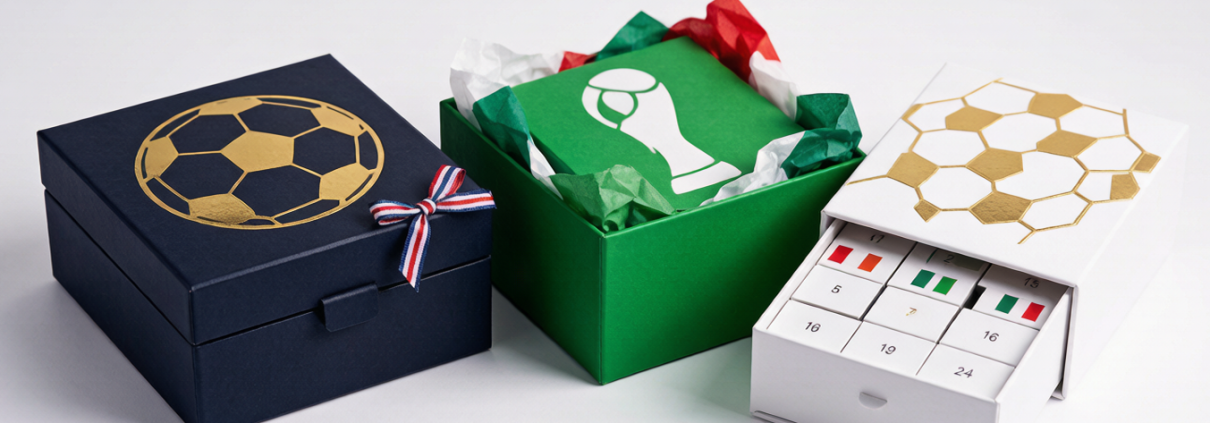
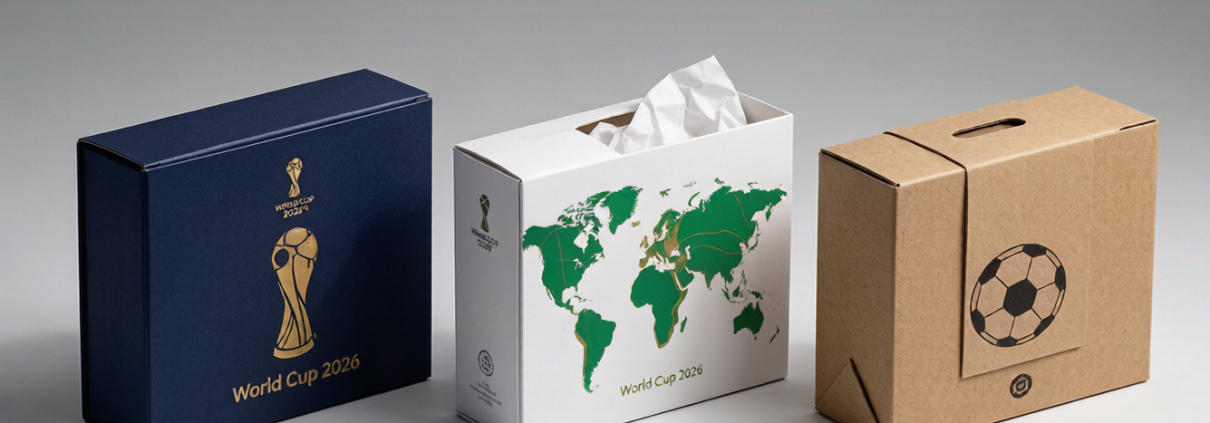
Abstract football-inspired geometric patterns — hexagon tessellations (from the soccer ball panel), world map overlays, jersey number typography, flag color block compositions. This theme is universally appealing and avoids any licensing concerns while still communicating “World Cup energy” immediately.
3. Best Box Structures for Fan Gift Sets
The box structure determines the unboxing experience — and for a World Cup gift, the reveal moment matters as much as the contents. Here are the top four structures suited for sports gift sets:
Structure
Best For
World Cup Application
Price Range
Magnetic Lid Box
Premium gift sets, luxury brands
Single-hero item with surrounding accessories; dramatic lid reveal
$3.50 – $8.00/unit
Drawer-Style Box
Multi-item gift sets
Multiple “matchday essentials” in individual compartments; build anticipation with the pull-out reveal
$4.00 – $9.00/unit
Double-Door / Book Box
Experience-focused brands
Grand opening that mirrors kickoff excitement; perfect for premium food or beauty sets
$4.50 – $10.00/unit
Folding Carton Bundle
Mass-market retail, promotional
Budget-friendly option for large-volume brand activations; flat-ship, self-assemble
$0.80 – $2.50/unit
Design Insight: For World Cup gift boxes, consider a ball-shaped foam insert or die-cut insert shaped like a soccer field viewed from above. Placing the hero product in the center of a field-shaped cutout creates an instantly recognizable visual moment that photographs incredibly well for social media.
4. What to Put Inside a World Cup Gift Box
The best fan gift sets include a mix of functional and keepsake items. Here are curated content ideas organized by price tier:
Premium Set ($50–$120 retail)
🧣 Premium team scarf or branded cap
🍺 Branded insulated tumbler or stainless steel water bottle
🍫 Football-shaped chocolates or artisan snack set (4–6 pieces)
📓 Leather-bound notebook with World Cup schedule insert
🏅 Enamel pin or keepsake medal in presentation sleeve
🎴 Custom playing cards with host city photography
Mid-Range Set ($25–$50 retail)
⚽ Mini replica football keychain or desk accessory
☕ Branded ceramic mug with team colors
🍪 Individually wrapped football-shaped cookies or chocolates
📱 Phone grip / PopSocket with World Cup graphics
🎫 Branded tote bag or drawstring bag
Budget Set ($10–$25 retail / Corporate Promo)
🧢 Branded cap or bandana
🍬 Candy or snack pouch in team colors
📎 Branded stationery set (pen + notepad)
🎉 Mini inflatable football or noise-maker
Packaging Tip: Regardless of contents tier, branded tissue paper + color-matched shredded paper fill + a personalized message card dramatically elevates perceived value at minimal cost. Use your primary brand color + one World Cup accent color (green, gold, or national team color) for the tissue and fill.
5. Printing & Finish Options for Maximum Impact
World Cup gift boxes live and die by visual impact. Here’s how to use printing and finishing to make your box stand out:
Premium ⭐⭐⭐
Gold/Silver Foil Stamping
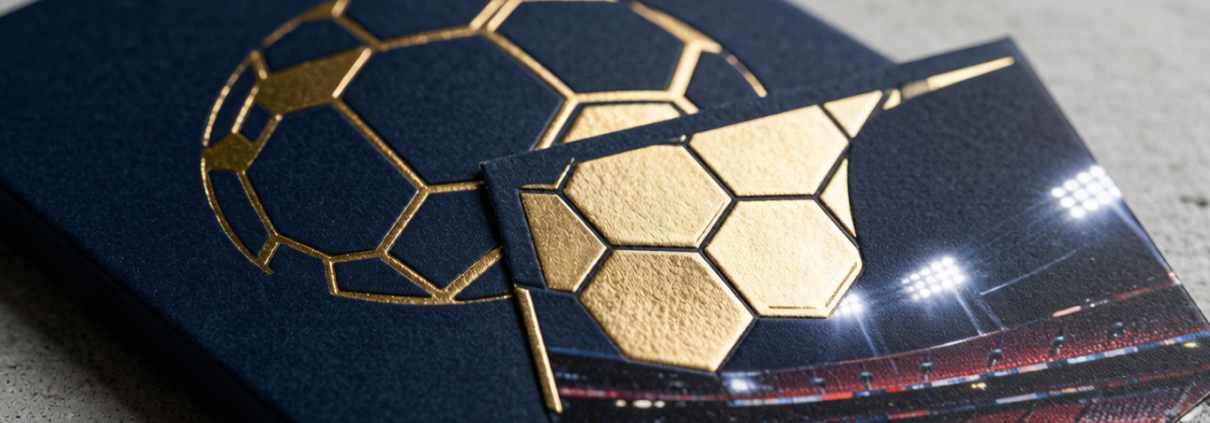
Apply metallic foil to the FIFA World Cup trophy silhouette, ball graphics, or brand logo. The shimmer effect is instantly premium and photographs beautifully.
Premium ⭐⭐⭐
Soft-Touch Matte + Spot UV
Matte background with glossy UV highlights on football panels or star elements. Creates a tactile “velvet vs. glass” contrast that feels luxurious.
Mid ⭐⭐
Full CMYK Photographic Print
High-resolution stadium photography or action shots wrapped around the box exterior. Powerful for experiential brands and fan merchandise.
Budget ⭐
2-Color + Varnish
Cost-effective option using two Pantone colors (e.g., national team colors) with a gloss varnish. Ideal for large-volume promotional gift boxes.
6. Color Palettes by Host Country
If you’re targeting specific regional markets, aligning your gift box color palette with the host nation creates an immediate emotional connection. Here are the Pantone equivalents for each host country:
Host Country
Primary Colors
Pantone Reference
Mood / Feel
🇺🇸 USA
Red + White + Navy Blue
PMS 200 C · White · PMS 289 C
Bold, patriotic, confident
🇲🇽 Mexico
Green + White + Red
PMS 349 C · White · PMS 200 C
Vibrant, festive, energetic
🇨🇦 Canada
Red + White
PMS 485 C · White
Clean, friendly, bold
⚽ Universal Football
Pitch Green + Gold + Black
PMS 362 C · PMS 116 C · Black
Premium, trophy-inspired, timeless
7. How to Source Custom World Cup Gift Boxes Fast
The World Cup final is July 19 — there are still 37 days left in the tournament. If you start today, you can still receive custom-printed gift boxes in time for the knockout stages. Here’s the fastest path:
Define your brief (Day 1–2): Decide on box structure, size, approximate quantity (500/1,000/5,000+), key contents dimensions, and design direction (color theme, finish level). The more specific you are, the faster the quote.
Request quotes from 2–3 suppliers (Day 2–4): Contact verified packaging manufacturers on Alibaba or direct factory websites. Share your brief, request a detailed quote including tooling/dieline costs, material specs, and lead time.
Approve design and dieline (Day 3–7): Work with the supplier’s design team or your own to finalize the print-ready artwork. Most factories provide a structural dieline template for free within 24 hours.
Confirm pre-production sample (Day 5–10): For orders over 1,000 units, request a physical sample. For urgent orders under 500 units, approve via high-resolution digital 3D mockups to save 7 days.
Mass production (Day 8–25): Standard rigid box production takes 20–28 days. Folding cartons can be produced in 15 days. Rush production (with 20% surcharge) can compress this to 12–15 days.
Air freight to destination (Day 25–32): Air freight from China to the USA takes 5–7 days; to Europe 5–8 days. Add 2–3 days for customs clearance. Total timeline: under 35 days from inquiry to arrival.
Speed Hack: If you need boxes in under 3 weeks, ask suppliers about stock rigid boxes (white or kraft, standard sizes) that can be wrapped with a custom-printed sleeve or label. This bypasses full custom production time and can be ready in 7–10 days. It won’t have the same premium feel, but it delivers the branding at speed.
Frequently Asked Questions
What is the best box structure for a World Cup gift set?+
Can I create World Cup gift boxes without FIFA licensing?+
How many items can I put in a World Cup gift box?+
Is it too late to order custom World Cup gift boxes now?+
Ready to Create Your World Cup 2026 Gift Box?
Get a free quote and 3D mockup within 24 hours from SOKPACK’s packaging team. Rush production available — let’s still make the tournament window work for you.
15+ years in custom gift box manufacturing and export. Specializing in event-driven packaging, sports gift sets, and rapid custom production for global brands.
https://sokpack.com/wp-content/uploads/2026/06/World-Cup-Gift-Boxes-4.png6261368administratorhttps://sokpack.com/wp-content/uploads/2026/08/logo11.pngadministrator2026-06-12 04:05:082026-06-25 02:36:07World Cup 2026 Gift Box Ideas: How to Create the Ultimate Fan Gift Set
From structure to sustainability — everything you need to know to create an advent calendar box that sells.
Why Advent Calendar Packaging Matters More Than Ever
The global advent calendar market is projected to reach $3.8 billion by 2025, growing at a compound annual rate of 7.4%. What started as a chocolate-only tradition has expanded into beauty, skincare, wine, food, toys, candles, and even DIY craft kits.
But here’s what many brands overlook: the box itself has become the product.
On TikTok alone, the hashtag #adventcalendar has accumulated over 4.2 billion views. Consumers don’t just buy advent calendars for what’s inside — they buy them for the ritual of opening one small door or drawer each day. The packaging is the experience.
For brands and private-label businesses, this means the advent calendar box isn’t just a container. It’s a marketing tool, a social media asset, and often the deciding factor in whether a customer chooses your product over a competitor’s.
“In the premium advent calendar segment, packaging accounts for up to 40% of the perceived product value. A well-designed box doesn’t just protect — it sells.” — Packaging Insights Europe, 2025
This guide walks you through the entire design process, from choosing a structure to selecting materials, printing techniques, and sustainability considerations. Whether you’re launching your first advent calendar or refining an existing design, here’s everything you need to know.
Step 1: Choose Your Box Structure
The structure is the foundation of your advent calendar box. It determines how customers interact with your product, how it ships, and how much it costs to produce. Here are the four most common structures, each with distinct advantages.
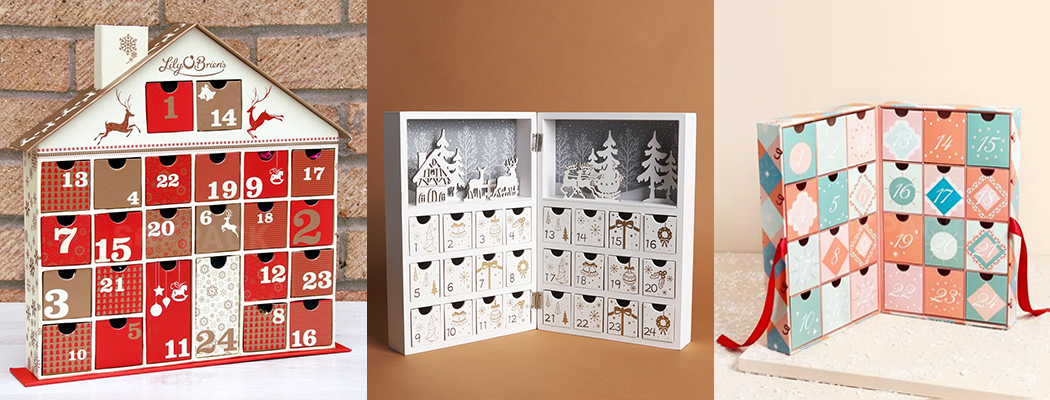
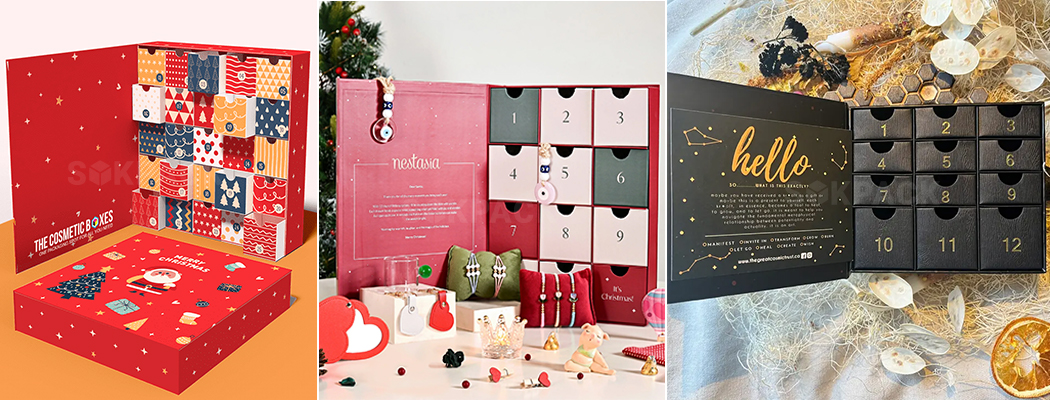
1. Drawer-Style Boxes
Each day is revealed by pulling out a small drawer. This is the most popular structure for beauty advent calendars because it creates a satisfying tactile interaction.
Best for: Beauty, skincare, jewelry, small accessories
Compartments: Typically 24 (standard advent) or 25 (including a bonus reveal)
Pros: Premium feel, easy to manufacture, strong shelf presence
Cons: Higher material usage per unit, requires precise alignment
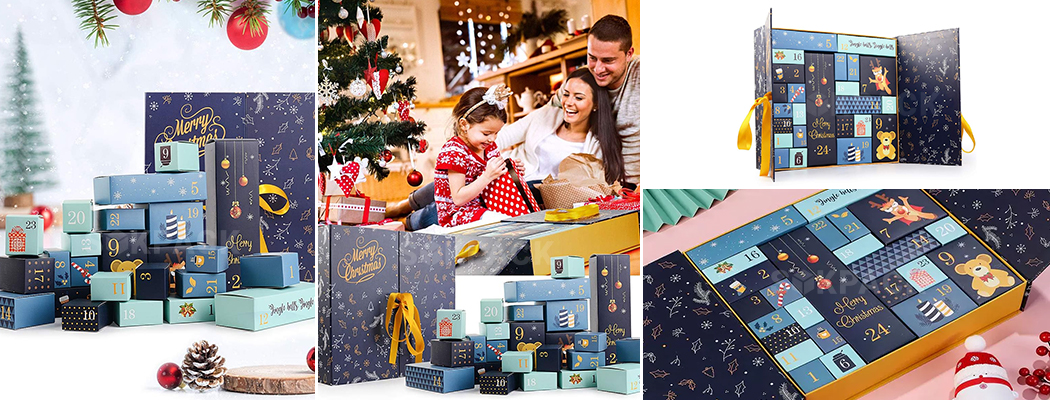
2. Double-Door Boxes
Two panels open like French doors to reveal numbered windows or perforated tear-off sections behind them. Classic, elegant, and deeply associated with the traditional advent calendar experience.
Best for: Chocolate, confectionery, gourmet food, toys
Cons: Less interactive than drawers, windows can tear unevenly
3. Flip-Top / Lid Boxes
A single lid lifts to reveal a grid of compartments beneath. Simple, clean, and practical — ideal when the focus should be on the contents rather than the packaging mechanics.
Best for: Tea, coffee, snacks, craft kits, candles
Pros: Easy to open, low tooling cost, versatile compartment shapes
Cons: Less dramatic reveal, contents visible at once
4. Accordion / Fold-Out Boxes
The box unfolds horizontally or vertically to reveal compartments in sequence. A less common but highly distinctive structure that stands out on shelves and in social media content.
Best for: Premium beauty, limited editions, wine and spirits
Cons: Complex tooling, higher production cost, requires more display space
Structure Selection Quick Guide
Beauty & Skincare → Drawer-style (most expected by consumers)
Chocolate & Confectionery → Double-door with windows (traditional appeal)
Wine & Spirits → Tiered or accordion fold-out (premium positioning)
DIY & Crafts → Flip-top with numbered compartments (practical access)
Step 2: Select the Right Materials
Material selection affects durability, print quality, sustainability credentials, and cost. Here’s a practical breakdown of the most common options for advent calendar boxes.
Material
Weight / Thickness
Best For
Cost Level
Eco-Rating
SBS (Solid Bleached Sulfate) Paperboard
250–400 gsm
High-end rigid boxes, luxury finishing
High
Moderate
Greyboard (Chipboard)
1.0–2.5 mm
Rigid box structure walls
Low–Medium
Good (recyclable)
FSC-Certified Cardboard
300–450 gsm
Eco-friendly full-wrap boxes
Medium
Excellent
Kraft Paperboard
250–350 gsm
Natural/organic aesthetic, simple structures
Low
Excellent
Corrugated E-Flute
1.0–1.8 mm
Shipping-friendly, lightweight options
Low
Good
Inner Trays and Inserts
The compartments inside your advent calendar need individual inserts to hold products securely. Common insert materials include:
Molded pulp — Made from recycled paper fiber, fully biodegradable. The most sustainable option. Ideal for food-grade applications.
Die-cut cardboard dividers — Cost-effective, printable, recyclable. Best for lightweight items like tea bags or small cosmetics.
Fabric or velvet inserts — Reserved for luxury jewelry or premium beauty calendars. High perceived value but non-recyclable.
PET film windows — Transparent, food-safe, and recyclable (PET #1). Used when customers should see the product through the compartment.
SOKPACK Tip: Food-Safe Certification
If your advent calendar will contain chocolate, snacks, tea, or any food-contact product, make sure your packaging supplier can provide FDA-compliant or EU food-contact certified materials. This is non-negotiable for food brands entering the US or European market.
Step 3: Design for the Unboxing Experience
With advent calendars, the unboxing isn’t a single moment — it’s a 24-day experience. Your design needs to account for how the box looks, feels, and functions over the entire countdown period.
Visual Hierarchy
Numbers must be prominent. Day 1 through Day 24 (or 25) should be clearly legible. Use a font size of at least 14pt and high contrast against the background.
Create visual progression. Consider a subtle gradient, pattern evolution, or color shift that progresses from Day 1 to Day 24 — it creates a sense of journey and anticipation.
Reserve a “wow” moment for the final day. The last compartment (often Day 24 or 25) should feel special — larger, differently designed, or positioned as the centerpiece of the box.
Tactile Design
Drawer pulls and ribbon tabs. Small physical handles on each drawer or tab make the daily ritual feel more intentional and premium.
Magnetic closures. If your box has a main lid or door, magnetic closures add a satisfying “snap” when opening and closing.
Texture contrast. A matte exterior with glossy numbered accents, or a soft-touch laminate with foil-stamped numbers, creates tactile interest that encourages sharing on social media.
After-Life Design (Second Life)
One of the fastest-growing trends in advent calendar packaging is “second-life” design — boxes that serve a purpose after the countdown is over. Examples include:
Drawer boxes that become a jewelry organizer or desk tidy
Calendar boxes that convert into a photo frame or display shelf
Boxes with reversible panels that become home decor after the holidays
This is not just a design choice — it’s a sustainability statement and a powerful marketing angle. In consumer surveys, 67% of advent calendar buyers say they would pay more for a box they can reuse.
Step 4: Pick Your Printing & Finishing Techniques
The finishing techniques you choose directly impact perceived value. Here’s a practical guide to what works best for advent calendar boxes.
Essential Techniques
Technique
Effect
Cost Impact
Best Used For
Foil Stamping
Metallic accent on logos, numbers, borders
+15–25%
Luxury positioning, premium branding
Embossing / Debossing
3D raised or recessed pattern on paper surface
+10–20%
Brand logos, decorative patterns
Spot UV Coating
Glossy highlight on specific areas over matte base
+8–15%
Number highlights, graphic accents
Soft-Touch Lamination
Velvety, fingerprint-resistant matte surface
+10–18%
Beauty and premium lifestyle brands
Die-Cut Windows
Custom-shaped openings revealing contents or pattern
+12–20%
Food calendars, peek-a-boo product reveals
Laser-Cut Details
Precise, intricate cut patterns in the paper
+20–35%
Limited editions, artistic positioning
Design Tip: Less Is More
For advent calendar boxes, resist the temptation to layer every technique at once. The most effective designs typically combine one primary technique (e.g., foil stamping) with one secondary technique (e.g., soft-touch lamination). Overloading techniques creates visual noise and drives up cost without proportional value gain.
Step 5: Integrate Sustainability
Sustainability in advent calendar packaging has moved from “nice to have” to “must have” — especially for the European market. In 2025, 73% of UK consumers said they would choose a more sustainable advent calendar over a non-sustainable alternative at the same price point.
Practical Sustainability Checklist
FSC-Certified Paper — Use paper and board sourced from responsibly managed forests. This is the single most impactful credential you can add.
Eliminate Plastic Windows — Replace PVC windows with PET (recyclable #1), cellulose acetate (biodegradable), or open die-cut designs with no film at all.
Soy-Based or Water-Based Inks — Replace petroleum-based inks with vegetable-based alternatives. They perform identically on press and are easier to de-ink during recycling.
Minimize Mixed Materials — The harder it is for consumers to separate materials, the less likely they are to recycle correctly. Aim for single-material designs (all-paper or all-cardboard).
Design for Flat Shipping — Fold-flat or knock-down designs reduce shipping volume by 40–60%, cutting both costs and carbon emissions.
Second-Life Function — As discussed in Step 3, designing the box to be reusable after the holidays reduces waste and adds functional value.
Communicating Sustainability
Don’t just make sustainable choices — tell your customers about them. Print your sustainability credentials on the box itself:
“FSC Certified — Made with paper from responsible sources”
“100% Recyclable — Please recycle this box”
“Plastic-Free Packaging”
“Designed for a Second Life — Reuse as a storage box”
“Printed with Soy-Based Inks”
Step 6: Plan for Production
Designing a great advent calendar box is only half the challenge. Getting it produced on time, at the right quality, and within budget requires careful production planning.
Typical Production Timeline
Phase
Duration
What Happens
Design & Dieline
3–5 days
Finalize artwork, create structural dieline, approve 3D mockup
Prototyping
5–7 days
Physical white sample → printed color sample → final approval
Tooling & Setup
7–10 days
Die-cutting rules, printing plates, foil stamping dies
Packed on pallets, loaded for sea freight or air cargo
Critical timing note: Most brands finalize their advent calendar designs in June–July and need stock ready by September–October for pre-sale campaigns. If you’re a brand planning for Christmas 2026, you should begin working with your packaging supplier by April or May at the latest.
MOQ & Cost Considerations
Typical MOQ: 300–500 units for custom advent calendar boxes. Some manufacturers offer lower MOQs (100 units) with a price premium.
Unit price range: $0.50–$2.50 for standard cardboard boxes; $4.00–$8.00 for luxury rigid boxes with foil and soft-touch finishing.
Cost drivers: Material choice, number of finishing techniques, number of colors, structural complexity, and order quantity all affect per-unit pricing.
SOKPACK Production Capabilities
At SOKPACK, we specialize in custom advent calendar box manufacturing with a 20,000+ sqm production facility, 15+ years of OEM/ODM experience, and a 7–15 day sample-to-shipment turnaround. We work with brands like Nestle, Ferrero, JBL, and Logitech to deliver packaging that elevates products and drives sales.
7 Common Mistakes to Avoid
Starting Too Late. The #1 mistake brands make. Production lead times for custom advent calendar boxes are 30–50 days. Add design and prototyping, and you need at least 3 months before your target stock date.
Ignoring Sustainability. In 2026, an advent calendar box without any sustainability credentials will lose shelf space in major European retailers. FSC certification and plastic-free design should be baseline, not premium.
Overcomplicating the Structure. More moving parts mean more assembly time, higher defect rates, and increased shipping damage risk. Start with a proven structure and differentiate through graphics and finishing.
Neglecting the Unboxing Sequence. The daily reveal is the core experience. If customers can see all 24 compartments at once (without an element of discovery), you’ve lost the magic.
Using Mixed Materials. Combining plastic windows, metal hinges, fabric lining, and foil-stamped cardboard creates recycling confusion. Consumers increasingly reject packaging they can’t easily separate.
Skipping Physical Prototypes. Digital renders look perfect — real boxes don’t always. Always approve a physical sample before committing to mass production.
Underestimating Shipping Volume. A fully assembled advent calendar box is bulky. Designing for flat-pack shipping can reduce your shipping volume by 40–60% and significantly cut freight costs.
Frequently Asked Questions
How much does a custom advent calendar box cost?
Prices range from $0.50–$2.50 per unit for standard printed cardboard boxes (MOQ 500+) to $4.00–$8.00 per unit for luxury rigid boxes with premium finishing like foil stamping and soft-touch lamination. Final pricing depends on material, structure complexity, finishing techniques, and order quantity.
What’s the minimum order quantity (MOQ) for custom advent calendar boxes?
Most manufacturers set MOQ at 300–500 units. Some offer lower MOQs (100 units) with a surcharge. For first-time projects, consider splitting your order: a smaller initial run for testing and a larger follow-up order for the holiday season.
How long does production take from design approval to delivery?
Typically 30–50 days total, including prototyping (5–7 days), tooling (7–10 days), mass production (15–25 days), and shipping (7–15 days by sea). Air freight can reduce shipping to 3–5 days but significantly increases cost.
Can I make my advent calendar box fully recyclable?
Yes. Use FSC-certified cardboard with soy-based inks, eliminate plastic windows (use die-cut openings instead), and avoid mixed materials like fabric or metal hinges. The entire box, including any printed inserts, should be recyclable in standard paper/cardboard streams.
What certifications should I look for in a packaging supplier?
Key certifications include FSC (responsible forestry), ISO 9001 (quality management), ISO 14001 (environmental management), BSCI/SEDEX (social compliance), and FDA compliance if your calendar contains food products. For EU markets, REACH compliance is also important.
How do I make my advent calendar box stand out on social media?
Three strategies work best: (1) Design for the reveal — each compartment opening should feel like a mini-event worth filming; (2) Use premium finishing — soft-touch lamination and foil stamping look exceptional in photos and videos; (3) Include a second-life feature — it gives influencers a natural “sustainability angle” for their content.
Ready to Create Your Advent Calendar Box?
Get a free structural design consultation and sample quote from our packaging engineers.
About SOKPACK
SOKPACK is a premium packaging manufacturer based in China, specializing in custom gift boxes, advent calendar packaging, and retail-ready solutions. With over 15 years of experience and a 20,000+ sqm production facility, we serve global brands including Nestle, Ferrero, JBL, and Logitech with OEM/ODM packaging that elevates products and drives sales.