Advent Calendar Box Wholesale: The Complete Buyer’s Guide 2026
The global advent calendar market is projected to reach $7.2 billion by 2034, growing at a compound annual rate of 7.4%. For beauty brands, food companies, and lifestyle businesses, the advent calendar box is no longer a seasonal novelty — it’s a strategic revenue driver and brand statement.
But if you’re sourcing advent calendar boxes for the first time — or looking to switch suppliers — the process can feel overwhelming. MOQs, material choices, structural engineering, printing finishes, lead times, quality control… there’s a lot to get right. One wrong decision can cost you thousands and cost you the holiday selling window.
This guide breaks down everything you need to know about ordering advent calendar boxes wholesale, from selecting the right supplier to getting production-ready samples. Written by a manufacturer with 15+ years of experience in custom packaging export.
Table of Contents
Key Takeaway: The most successful brands place their advent calendar box orders between June and August for a November/December launch. Starting early gives you access to better pricing, more supplier capacity, and — most importantly — time for revisions.
1. Types of Advent Calendar Boxes
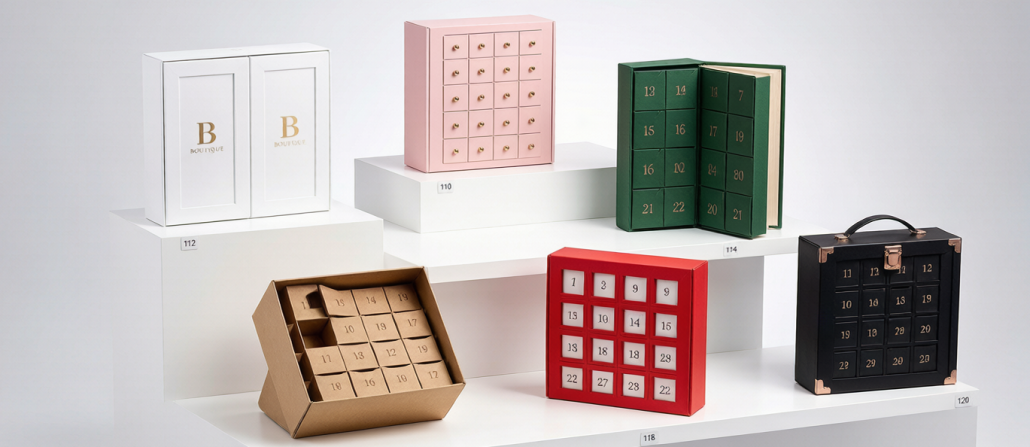
Not all advent calendar boxes are created equal. The structure you choose affects everything from perceived value to shipping costs. Here are the five main styles available from wholesale manufacturers:
| Box Type | Structure | Best For | Price Range (per unit) |
|---|---|---|---|
| Drawer-Style | 24 pull-out drawers in a frame | Beauty, jewelry, small lifestyle items | $2.80 – $7.00 |
| Double-Door Rigid | Two doors open to reveal compartments | Premium beauty, food & confectionery | $4.00 – $10.00 |
| Book-Style / Flip-Top | Book-like cover opens to numbered trays | Tea, coffee, stationery, hobby kits | $3.00 – $8.00 |
| Window Reveal | Punch-out windows revealing hidden contents | Confectionery, toys, kids’ products | $1.20 – $3.50 |
| Folding Carton | Pre-glued flat-pack, pop-up structure | Budget-friendly brands, promotional calendars | $0.80 – $2.50 |
Pro Tip: If your product varies in size (e.g., some days have full-size products and others have samples), consider a mixed-compartment design — larger drawers for premium days and smaller ones for sample days. This is common in beauty advent calendars and can be engineered at no extra tooling cost for orders over 2,000 units.
2. Pricing Guide: What to Expect
Pricing varies significantly based on material, finish complexity, structure, and order volume. Here’s a realistic pricing benchmark based on 2025–2026 market data from verified Alibaba suppliers:
| MOQ Range | Folding Carton | Standard Rigid | Premium Rigid (Foil + Emboss) |
|---|---|---|---|
| 200 – 500 | $1.50 – $2.80 | $3.50 – $6.50 | $6.00 – $12.00 |
| 500 – 2,000 | $1.00 – $2.20 | $2.80 – $5.00 | $4.50 – $8.50 |
| 2,000 – 10,000 | $0.80 – $1.50 | $2.20 – $4.00 | $3.50 – $7.00 |
| 10,000+ | $0.50 – $1.00 | $1.80 – $3.50 | $3.00 – $5.50 |
What Drives the Price Up or Down?
- Material grade: Upgrading from standard art paper to specialty textured paper adds 15–25% per unit
- Foil stamping: Gold or silver foil adds $0.30–$0.80/unit depending on coverage area
- Embossing/debossing: Adds $0.20–$0.50/unit per impression
- Magnetic closures: Hidden magnets add $0.15–$0.40/unit
- Spot UV coating: Adds $0.10–$0.30/unit
- Custom inserts (EVA foam, molded pulp, velvet tray): Adds $0.50–$2.00/unit
Beware of Suspiciously Low Pricing: If a supplier quotes $0.40/unit for a rigid drawer-style box with foil stamping, that’s a red flag. Unrealistically low pricing usually means: (1) inferior board thickness, (2) low-coverage foil that flakes, or (3) outsourced to sub-par workshops. Always request a physical sample first.
3. Materials & Finishes
The material you choose defines the perceived quality, structural integrity, and sustainability story of your advent calendar box. Here’s a breakdown of the most popular options:
Board Materials
- Grey Board (800–1400gsm): The structural backbone of rigid boxes. Provides firmness and durability. Thickness of 1.5–2.5mm is standard for advent calendars.
- C1S Art Paper (157gsm–350gsm): Coated on one side, used as the outer wrap for rigid boxes and the primary material for folding cartons. Smooth surface ideal for high-quality printing.
- Natural Kraft Paper: Uncoated, fibrous texture. Popular for eco-conscious brands. Available in standard and FSC-certified grades.
- Specialty Papers: Textured linen, metallic-finish, holographic, and pearlescent papers for premium positioning.
Finishing Options
- Hot Foil Stamping: Gold, silver, rose gold, copper, or holographic foil. The #1 finish for luxury advent calendars.
- Emossing / Debossing: Creates raised or recessed logos and patterns. Adds tactile dimension.
- Soft-Touch Lamination: Velvet-like matte finish. Extremely popular in beauty packaging.
- Spot UV: Glossy highlights on specific design elements against a matte background.
- Varnish (Gloss or Matte): Budget-friendly protective coating. Matte is the current market preference.
- Magnetic Closures: Hidden magnets in the lid for a satisfying “snap” open/close.
Combination Recommendation: For a premium beauty advent calendar, the industry standard finish is soft-touch lamination + gold foil stamping + embossing. This combination delivers the tactile “unboxing feel” that drives social media sharing. Expect to pay $0.50–$1.20/unit extra for this combo on rigid boxes.
4. How to Choose a Supplier
Your supplier choice can make or break your holiday season. Here’s a structured evaluation framework to assess potential manufacturers:
- Check Manufacturing Experience: Ask specifically about advent calendar box production. General gift box manufacturers may lack the structural engineering expertise needed for 24+ compartment designs. Look for 5+ years in this specific product category.
- Verify Certifications: ISO 9001 (quality management), FSC (Forest Stewardship Council for sustainable materials), Disney FAMA (if targeting licensed products), and BSCI (social compliance for EU markets).
- Request Pre-Production Samples: Never place a bulk order without seeing a physical sample first. A good supplier will produce a sample with your exact design, materials, and finishes within 7–10 working days. Budget $50–$150 per sample.
- Evaluate Communication: How quickly do they respond to inquiries? Do they provide detailed, specific answers or generic templates? Response time under 24 hours is a good indicator of professional service.
- Ask for Factory Audit Documentation: Production capacity photos, equipment lists, and — if possible — a live video factory tour. Legitimate manufacturers are transparent about their facilities.
- Check Trade Assurance / Reviews: On Alibaba, verified suppliers with Trade Assurance and positive buyer reviews (50+ reviews, 4.5+ rating) provide financial protection and quality assurance.
5. Production Timeline & Planning
Timing is everything for advent calendar box production. The holiday window doesn’t wait for supply chain delays. Here’s a recommended timeline for a November/December launch:
| Phase | When | What Happens |
|---|---|---|
| Design & Quote | June – July | Finalize box structure, materials, artwork. Get quotes from 2–3 suppliers. Compare samples. |
| Pre-Production Sample | July – Mid-August | Supplier produces physical sample. You review, approve, or request revisions. |
| Bulk Production | Mid-August – September | 25–35 days of production. Includes printing, die-cutting, assembly, and finishing. |
| Quality Inspection | Late September – Early October | Final QC check (or hire third-party inspection). Confirm packaging for shipping. |
| Shipping & Delivery | October – November | Sea freight (25–35 days) or air freight (5–7 days). Account for customs clearance. |
| Product Filling & Launch | November | Boxes arrive at your warehouse. Fill with products. Prepare launch marketing. |
Critical Deadline: August 15 is your last comfortable date to confirm production orders. After that, many quality suppliers are at capacity and rush fees apply. Sea freight from China to the US takes 25–35 days; to Europe takes 30–40 days. Factor in 5–7 additional days for customs clearance.
6. Quality Control Checklist
Don’t wait until boxes arrive at your warehouse to discover quality issues. Use this checklist during the pre-production sample review and again during final QC before shipping:
- Structural integrity: Open and close the box 20+ times. Check for warping, splitting at joints, or loose compartments.
- Drawer/door mechanics: All drawers should pull out smoothly with consistent resistance. Double doors should align evenly when closed.
- Print quality: Colors should match your approved artwork (use Pantone references). Check registration (no overlapping or misaligned prints).
- Foil stamping: Foil should be crisp with clean edges — no flaking, patching, or blurred lines.
- Emossing quality: Raised/recessed areas should be even depth and sharp definition throughout.
- Adhesive cleanliness: No visible glue marks, excess adhesive strings, or residue on interior surfaces.
- Numbering accuracy: All 24 compartments should be correctly numbered in sequence (1–24).
- Material thickness: Board should meet specified GSM. Use a caliper to verify thickness at corners and center.
- Surface finish: Lamination should be bubble-free, spot UV should be precisely aligned, and overall surface should be clean and free of scratches.
- Packaging for shipping: Individual boxes should be wrapped or separated to prevent scratching during transit. Master cartons should be sturdy with proper cushioning.
Third-Party Inspection: For orders over 5,000 units, consider hiring a third-party QC company (SGS, Intertek, or Bureau Veritas) to conduct a Pre-Shipment Inspection (PSI) at the factory. Cost is typically $250–$400 per inspection — far less than the cost of receiving a container of defective boxes.
7. Sustainability Options
Sustainability is no longer optional — it’s a purchase criteria for 68% of European consumers and 55% of North American consumers. For B2B brands, retail buyers increasingly require eco-friendly packaging to meet their own sustainability commitments.
Here’s what’s available from wholesale suppliers right now:
- FSC-Certified Materials: Paper and board sourced from responsibly managed forests. Most quality suppliers can source FSC materials at a 5–10% premium.
- Recycled Content: Post-consumer recycled (PCR) cardboard and kraft paper. Typically 30–100% recycled content available.
- Soy-Based Inks: Replace petroleum-based inks for cleaner, more easily deinkable printing. Minimal cost difference.
- Water-Based Adhesives: Non-toxic, easier to recycle. Standard in most certified factories.
- Second-Life Design: Boxes engineered to be reusable after the holidays — as storage boxes, display cases, or keepsake containers. This is the fastest-growing trend in premium advent calendar packaging.
- Plastic-Free Inserts: Replace PET windows, PVC trays, and plastic inserts with molded pulp, corrugated inserts, or tissue paper dividers.
Market Insight: Advent calendars with “100% recyclable” or “FSC-certified” labeling command 15–20% higher retail prices compared to non-certified equivalents. For brands selling at $50+ price points, sustainable packaging is essentially a cost-neutral upgrade that unlocks a higher-price consumer segment.
8. 5 Common Ordering Mistakes
After 15 years in packaging manufacturing, we’ve seen brands repeat the same costly mistakes. Here’s how to avoid them:
Mistake #1: Ordering Too Late
Every year, brands scramble to place orders in October for a December launch. The result: rush fees (20–30% premium), limited supplier availability, air freight costs (3–5x sea freight), and quality compromises due to compressed timelines.
Fix: Start the supplier conversation in June. Lock in production by mid-August.
Mistake #2: Skipping the Pre-Production Sample
Approving designs digitally and going straight to bulk production is the single most expensive mistake. Print colors look different on physical material, structural issues only appear when you physically interact with the box, and finish quality varies significantly between suppliers.
Fix: Always order a pre-production sample. Budget 7–10 days and $50–$150 for this step.
Mistake #3: Choosing the Wrong Structure for Your Product
Putting full-size skincare bottles into a folding carton designed for small sample sachets leads to crushed boxes and unhappy customers. Conversely, using a premium rigid box for low-value promotional items wastes budget.
Fix: List your exact product dimensions for all 24 days before choosing a box structure. Ask your supplier to recommend the best structural fit.
Mistake #4: Ignoring Shipping Dimensions
A beautifully designed 40cm tall advent calendar might look stunning on Instagram, but it’ll cost a fortune to ship — especially if you’re selling D2C. Shipping costs are calculated by volumetric weight, not actual weight.
Fix: Design within 30cm x 30cm x 10cm for optimal shipping economics. This fits standard courier size limits and keeps volumetric weight manageable.
Mistake #5: Not Planning for Assembly
Many advent calendar boxes require some level of product insertion — placing items into numbered compartments, adding tissue paper, applying seals. If your team is manually filling 5,000 boxes, each taking 8 minutes, that’s 667 person-hours of assembly labor.
Fix: Factor assembly time and labor into your production schedule. Consider asking your supplier about pre-filled box options or simplified insertion designs.
Frequently Asked Questions
Ready to Start Your Advent Calendar Box Project?
Get a free quote and pre-production sample from SOKPACK’s engineering team. We’ve helped 200+ brands worldwide launch successful advent calendar campaigns. Get Free Quote →