SHENZHEN, China – July 9, 2026 – In the world of luxury retail, cosmetics, jewelry, and corporate gifting, the first physical touchpoint between a brand and its customer is rarely the product itself—it’s the Rigid Box. Unlike folding cartons that collapse and bend, a Rigid Box stands tall, feels substantial in hand, and signals quality before the lid is even lifted. But behind that weight, sharp corner, and flawless wrap lies a highly structured, precision-driven process: the rigid box manufacturing workflow.
For SOKPACK, a Shenzhen-based custom packaging manufacturer established in 2012, this process isn’t just technical—it’s a craft honed over more than a decade of serving global B2B brands. From material selection and V-groove scoring to automated wrapping and multi-stage QC, SOKPACK’s production line is designed to turn raw board into brand assets that protect, promote, and persuade.
This article walks through the complete rigid box manufacturing process, with a focus on materials, tooling, customization, quality control, and factory capability—the same standards that underpin every SOKPACK magnetic closure box, drawer box, Advent calendar, and luxury gift box shipped worldwide.
Table of Contents
1. What Makes a “Rigid Box” Different?
Before diving into the workflow, it’s worth clarifying why Rigid Box exist and how they differ from everyday folding cartons:
- Core Structure: Rigid box use high-density greyboard (typically 1000–1500 gsm) as a non-collapsible skeleton, wrapped in printed or textured paper.
- Durability: They resist compression, impact, and handling better than SBS or corrugated folding cartons.
- Perceived Value: Weight, edge sharpness, and magnetic or friction-fit closures create a luxury unboxing experience.
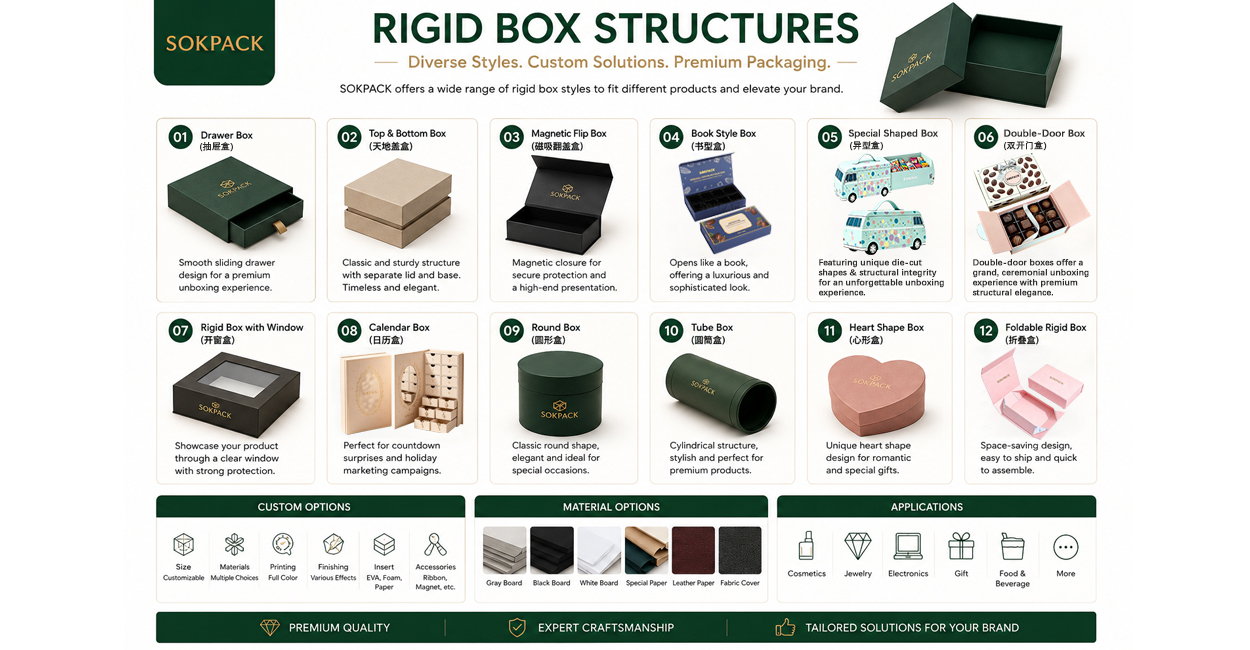
- Customization Depth: From book-style hinges to drawer glides, insert millings, and foil stamping, rigid boxes accommodate complex structures that folding cartons cannot.
At SOKPACK, rigid box production is treated as structural engineering + brand storytelling, not just “making boxes.”
2. Step-by-Step: The SOKPACK Rigid Box Manufacturing Process
2.1 Material Selection – The Foundation of Quality
Everything begins with the core board and wrap material, both of which determine strength, finish, and sustainability.
Greyboard / Chipboard (Core Board)
(1)Specification: SOKPACK commonly uses 1000 gsm (light items), 1200 gsm (standard), and 1500 gsm (heavy items like fragrance gift sets, watches).
(2)Selection Criteria: Based on product weight, box dimensions, and drop-test requirements.
(3)Sourcing: FSC®-certified options available; recyclable, high-compression greyboard with consistent density.
(4)Why it matters: Underweight board feels cheap; overweight board drives up freight unnecessarily. SOKPACK engineers strike the balance.
Wrap Papers & Finishes
(1)Art Paper (Coated/Uncoated): For CMYK or Pantone spot printing.
(2)Textured / Specialty Paper: Linen-look, leatherette (faux), Japanese washi-style, soft-touch matte.
(3)FSC Kraft: For eco-luxury positioning; pairs with soy-based inks and minimal foil.
(4)Lamination: Matte, gloss, soft-touch—adds moisture/scratch resistance and tactile quality.
Adhesives
(1)Water-based / PVAc adhesives: Strong, low-VOC, compatible with automatic wrapping machines.
(2)Hot-melt (selective use): For high-speed assembly where appropriate.
(3)Sustainability note: SOKPACK prioritizes solvent-free adhesives to align with global eco-packaging standards.
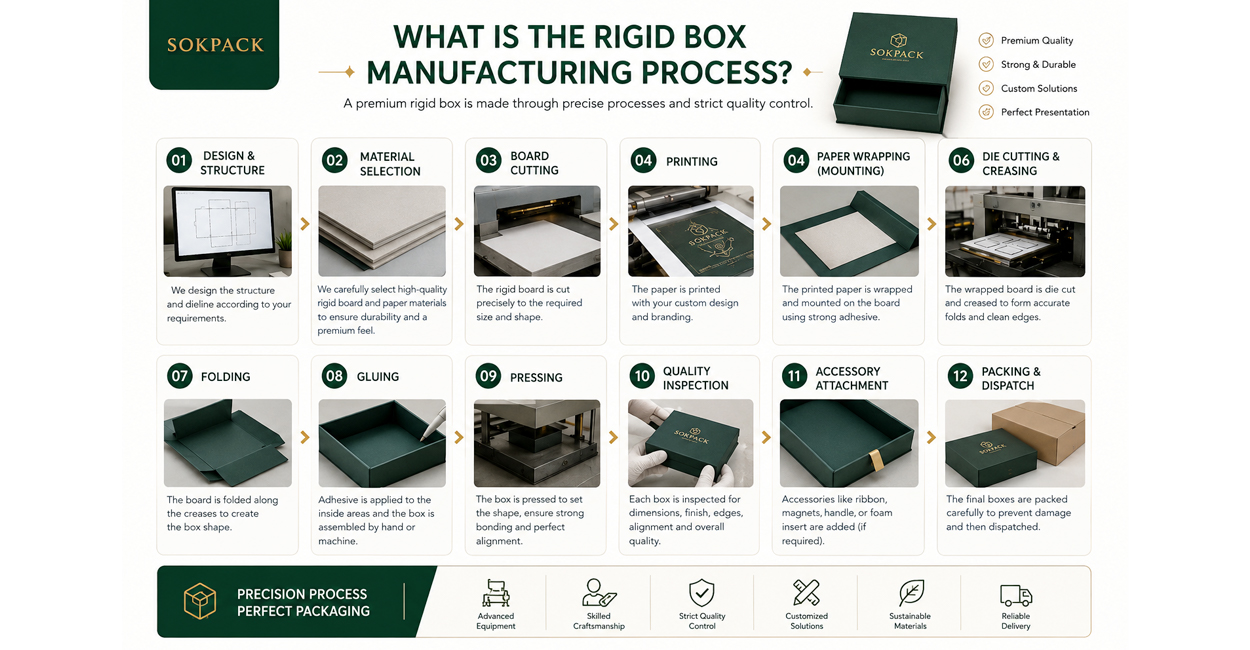
2.2 Cutting & Sizing – Accuracy First
Once materials are approved, die-cutting begins:
- Tools: Steel-rule dies, laser-cut dies for complex shapes (drawer notches, finger pulls, window cutouts).
- Process: Greyboard sheets and wrap papers are cut to exact dielines—lid, base, tray, insert components.
- Tolerance: ±0.5 mm or tighter for high-precision boxes (e.g., jewelry, electronics).
- Importance: Inaccurate cutting cascades into misaligned wraps, poor corner joins, and unstable structures later.
SOKPACK runs Heidelberg die-cutting machines and in-house CNC sample cutters to ensure consistency across prototypes and mass production.
2.3 V-Groove Scoring (Grooving Machine) – The Luxury Edge
This is where rigid boxes diverge from amateur “Rigid Box”:
- Technology: V-cut / V-groove scoring creates a precise angled channel along interior fold lines.
- Effect: When folded, the greyboard bends sharply along the V-line without cracking the surface or rounding the corner.
- Result: Crisp 90° exterior angles and tight interior corners—hallmarks of premium rigid boxes.
- Equipment: Computer-controlled grooving machines calibrate depth to board thickness (e.g., 1200 gsm ≈ X mm groove depth).
Without proper grooving, boxes look bulbous, corners bulge, and lids misalign. SOKPACK treats grooving as a critical control point in luxury packaging.
2.4 Wrapping & Laminating – The Face of the Brand
Wrapping is where structure meets branding:
Process: Cut wrap paper is fed with greyboard panels into automated wrapping machines or, for complex boxes, skillfully hand-wrapped by experienced operators.
SOKPACK’s wrapping lines integrate edge-folding mechanisms that tuck corners neatly—vital for magnetic closure boxes and book-style hinges where lid alignment is visible.
2.5 Box Formation & Corner Pasting – 3D Integrity
Now flat panels become three-dimensional rigid box:
- Corner Pasting: Corners are reinforced with adhesive (and sometimes paper tape) to prevent splaying under pressure.
- Alignment: Lid/base symmetry is checked; magnetic plates/magnets (neodymium) are embedded in designated cavities for magnetic closure boxes.
- Drawer Boxes: Sleeve and tray are assembled separately; finger-notch or pull-tab positions verified.
- Book-Style Hinges: Paper-spine hinges are pasted to ensure repeated open/close cycles without tearing.
This stage determines whether a box “feels” premium or flimsy. SOKPACK employs semi-automatic and manual finishing for complex structures, backed by jigs that hold dimensions steady during curing.
2.6 Insert Integration & Final Assembly
For many SOKPACK clients (beauty, jewelry, corporate gifting), the box isn’t complete without an insert:
- Types: Die-cut greyboard platforms, EVA foam (plain/velvet-lined), molded pulp, corrugated honeycomb.
- Fit: Custom-milled to product shape (ring slot, bottle neck cradle, serum vial cutout).
- Assembly: Inserts placed post-box formation; additional elements (ribbons, thank-you cards, magnets) added.
This is also when branding elements (embossed logo on insert, printed interior base) are verified for positioning.
2.7 Surface Finishing Touches
Depending on brand specs, SOKPACK applies:
- Hot Foil Stamping (Gold/Silver/Copper/Holographic)
- Blind Deboss / Emboss
- Spot UV
- Glitter / Textured Coating (select lines)
These are executed via foil stamping machines, letterpress, screen-coater units integrated with print workflows to ensure registration accuracy.
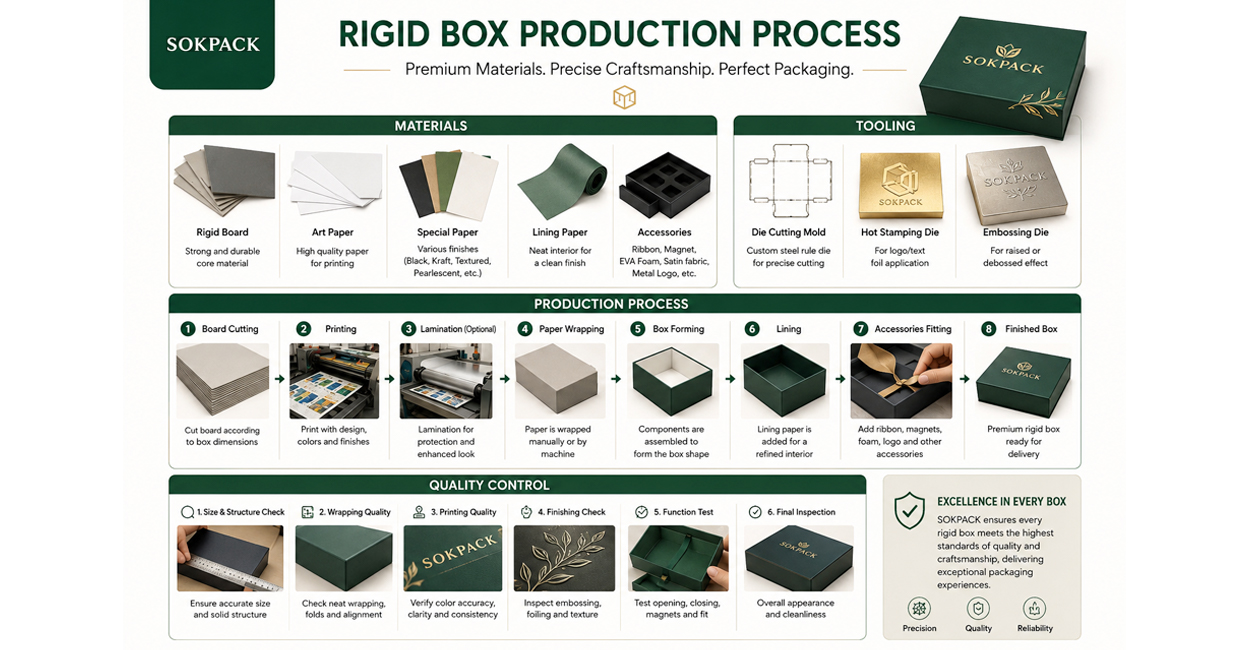
3. Tooling & Machinery – SOKPACK’s Production Backbone
A premium box requires premium tooling. SOKPACK’s Shenzhen facility and Dongguan production base (30,000㎡) house:
- Heidelberg Offset Presses: For high-fidelity CMYK/Pantone printing with color-managed workflows.
- Die-Cutting Machines: Steel-rule and laser dies for consistent sizing.
- V-Grooving Machines: CNC-controlled depth and angle settings.
- Automatic Rigid Box Makers: For high-volume, repeatable wrapping/forming (used where appropriate; complex boxes finished semi-auto/manual for quality control).
- Lamination & Wrapping Lines: Bubble-free application, edge-fold consistency.
- Sample Prototyping Equipment: In-house dieline creation (AI/CAD/PDF); 3–5 day sampling.
This infrastructure allows SOKPACK to pivot between low-MOQ custom runs (300–500 pcs) and large-scale seasonal programs (Advent calendars, holiday GWPs) without sacrificing consistency.
4. Quality Control – Six Checkpoints That Protect Your Brand
SOKPACK applies multi-stage QC aligned with ISO 9001 and client-specific AQL standards:
4.1 Raw Material Inspection
- Board GSM/thickness verified
- Adhesive bond strength tested
- Wrap paper print/color checked against approved proof
4.2 In-Process Inspection
- Dimensional accuracy (lid/base fit, drawer glide clearance)
- Groove depth & corner sharpness
- Wrap alignment, bubble check
4.3 Printing Alignment & Finishing Inspection
- Logo position, foil registration
- Color deviation (ΔE check vs. standard)
- Surface texture uniformity
4.4 Structural Strength Testing
- Corner Strength Test: Resistance to splaying/pressure
- Compression Test: Load-bearing capacity
- Drop Simulation (select projects): Validate protection for transit
4.5 Insert Fit Verification
Product mockup placed in insert to confirm snug fit, no shift
Lid closure tested over insert (clearance validated)
4.6 Final Inspection
- Full visual audit: scratches, smudges, hinge integrity, magnet strength
- Random sampling per batch
- Rejected units corrected or scrapped before packing
This layered QC ensures that when a SOKPACK box arrives at a brand’s 3PL or direct-to-store, it performs as engineered.
5. Customization & Material Tailoring at SOKPACK
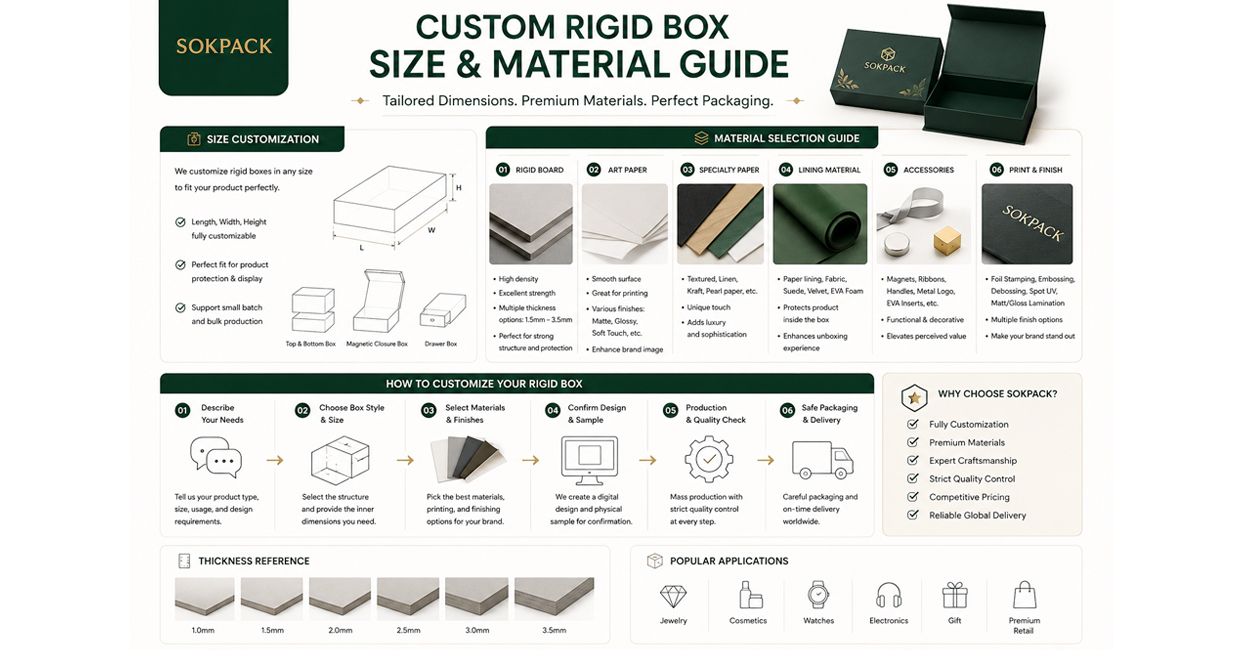
One size never fits all in luxury packaging. SOKPACK offers:
- Board Customization: GSM, density, FSC grade, double-wall greyboard for extra-heavy items.
- Wrap Customization: Printed, textured, sustainable kraft, leatherette; combination finishes (e.g., matte body + spot-UV logo).
- Structural Customization: Book-style, two-piece, drawer, fold-flat magnetic, Advent calendar grid, hybrid forms.
- Insert Customization: Material (EVA/foam/board/pulp), shape, depth, lining (velvet/suede).
- Closure Customization: Magnet strength/location, ribbon pulls, friction-fit tolerance tuning.
- Sustainability Customization: Mono-material builds, plastic-free magnetic catches, compostable wraps, FSC chain-of-custody.
Every custom spec is documented in dieline + spec sheet and validated via prototype before bulk.
6. SOKPACK Factory Strength & Global Service
Since 2012, SOKPACK has grown into a trusted B2B packaging partner by combining structural know-how with brand-sensitive execution.
Key Strengths:
✅ Two Production Bases: Shenzhen HQ + Dongguan 30,000㎡ facility
✅ FSC®, ISO 9001, Sedex Certified
✅ In-House Design Team: Dieline, 3D render, print-ready art support
✅ Low MOQ Flexibility: From 300–500 pcs for emerging brands
✅ DDP Shipping: To US / EU / UK / AU with logistics coordination
✅ Speed: 12–20 days standard production; 3–5 day sampling
✅ Experience: Serving beauty, jewelry, electronics, FMCG, apparel, corporate gifting
SOKPACK doesn’t just “make boxes”—it engineers retail-ready, gift-ready, and shelf-stable packaging that carries brand equity through the supply chain.
7. Conclusion: The Box Is Never “Just a Box”
The rigid box manufacturing process—from greyboard selection and V-groove scoring to wrapping, forming, and six-stage QC—is a chain of precision steps where one weak link compromises the whole. For brands competing on unboxing, gifting, and perceived value, the box is the first product experience and the last impression after use.
At SOKPACK, we treat each rigid box as a brand moment in 3D form: structurally sound enough to protect what’s inside, beautiful enough to be kept afterward, and responsible enough to align with where packaging—and the planet—are headed.
From dieline to delivery, we build boxes that work as hard as your brand does.
About SOKPACK
SOKPACK (Shenzhen SOKPACK Display Products Co., Ltd.) is a custom rigid packaging and retail display manufacturer established in 2012. Specializing in magnetic closure boxes, drawer boxes, Advent calendars, and eco-luxury gift packaging, SOKPACK serves global B2B clients with in-house design, certified materials, and end-to-end production across Shenzhen and Dongguan facilities.
📧 sales@sokpack.com
📦 Low MOQ • DDP Shipping • Free Dielines • Physical Samples on Request
 Premium custom rigid packaging solutions for brands worldwide.